 УЗ
УЗ
 РУ
РУ
 EN
EN
 العربية
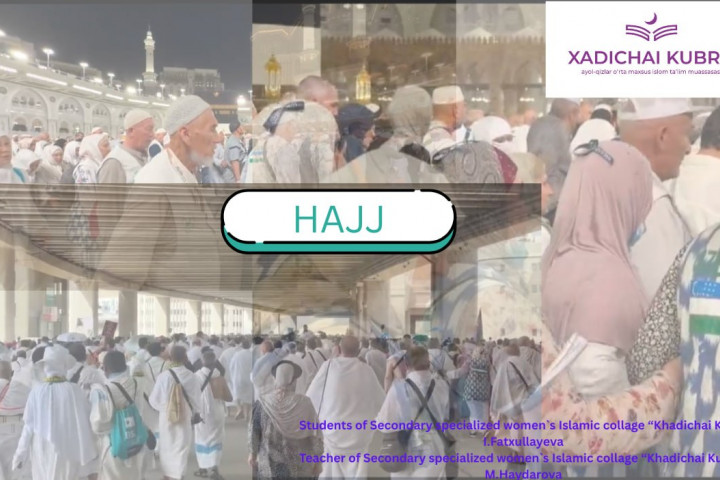
Hajj
Hajj is the pilgrimage to tlhe Ka'bah in Makkah; it is the fifth pillar of Islam. Allah says in the Qur'an: "Hajj to the House is a duty to Al lah for mankind, for him who can find a way to do it." (3:97). The main purpose of the hajj is to show obedience to Allah. The hajj is a way of worshipping Allah. It is the duty of each Muslim to go for hajj at least once in their lifetime as long as they can find a way to it and the family left behind is properly provided for.
In the centre of the Grand Mosque - Al-Masjid al-Haraam - in Makkah is the building known as the Ka'bah: the House of Allah . This was built by Prophet lbraaheem and his son lsma'eel . It was the first place for the worship of Allah on earth . We face the Ka'bah in Makkah in our prayers five times a day.
The lhram. lhram is the intention to perform hajj or umrah. Before entering Makkah, each pilgrim takes a bath and puts on a special dress for ihram. For men the ihram clothing consists of two unstitched pieces of cloth to cover the upper and the lower parts of their bodies. Women wear clothes which cover everything except their faces and hands. In fact, ihram clothing for ladies consists of their simple daily clothes. They are required to keep their faces and hands uncovered while in the state of ihram.
As all the pilgrims dress alike, many differences between them vanish. They are all equal . During the hajj , pilgrims must not cut their hair, wear perfume, or hunt or harm any living thing in any way, while in the state of ihram. They must make efforts not to get angry with others.
The Arabic term miqaat means the place around Makkah from which a pilgrim assumes the state of ihram. The pilgrim changes into ihram clothing at the miqaat and pronounces his intention to perform hajj or umrah. For people living inside the miqaat permanently, their place of residence is their miqaat. Once the pilgrim assumes the state of ihram, he becomes a muhrim. He offers two rak'ahsand pronounces his intention to perform hajj or umrah as the case may be. He then starts reciting the talbiyya loudly and frequently and continues to do so until he arrives at the Masjid ai-Haraam. Women recite the talbiyyah silently.
Now the first thing to do is to walk around the Ka'bah, saying prayers, seven times. This act is called 'tawaaf' . As each person gets to the Black Stone, he touches or kisses it while saying Allaahu Akbar just as Allah's Messenger (s.a.v.) did. Pilgrims who are too far away to do so raise their hands in its direction and say Allaahu Akbar.
After performing the tawaaf, pilgrims run or walk at a pace between two hillocks near the Ka'bah cal led Saf.a and Marwah. This act is called sa'ee. It reminds Muslims of the time lsma'eel and his mother Haajar had been left in the desert by Prophet lbraaheem (a.s) at Allah's Command. When their stock of water ran out and the child was thirsty, Haajar ran frantically between these two hillocks in search of water. Returning to lsma'eel , she found that a spring of water had gushed forth near him. This spring, called Zamzam, is now found underground, beneath the courtyard of the Ka'bah. Pilgrims go to drink some of the water before beginning the sa'ee.
After the sa'ee, halq (having the head shaven) or taqseer (having a haircut) follows. Pilgrims now shower and change into everyday clothes, depending on the type of hajj they perform. This completes the pilgrims' umrah. All restrictions of the ihram are now temporarily lifted from the pilgrim. He will now wait for the 8th of Dhul Hijjah to start the other rites of hajj .
On the 8th of Dhui-Hijjah, most pilgrims pronounce a new niyyah at their place of residence to perform hajj . There is no need for them to go to the miqaat for this reason. The pilgrims change into ihram clothing and proceed to Mina soon after the Fajr prayer. On the 8th day of Dhui-Hijjah, the first day of hajj , Muslims travel to Mina, about 8 kilometres from Makkah. Here they spend the night.
The next day (the 9th of Dhui-Hijjah), they travel to the plain of Arafah, about 22 kilometres from Makkah. They halt for the day in this plain and pray to Allah. They ask His forgiveness. It is a moving experience to join together with as many as three million other pilgrims in the same place for one purpose: to worship Allah. This gathering reminds the pilgrims of the day when everyone will be brought before Allah for judgement.
At sunset, the pilgrims travel to Muzdalifah. This is a bare rocky place back in the direction of Makkah, midway between Arafah and Mina. The pilgrims spend the night there. They combine the Maghrib and lsha prayers together and shorten the lsha prayer to two rak'ahs. They also offer the Fajr prayer there and collect pebbles ready for the next day when they reach Mina.
At Mina, there are three stone pillars called jamraat. The jamraat are located within a few hundred feet of one another in a line. They remind Muslims that it was here that Shaytan hopelessly tried to tempt lbraaheem (a.s) not to perform the sacrifice Allah wanted. Pilgrims pelt the Aqabah pillar with the pebbles they have already collected from Muzdalifah. This symbolic action shows that it was not only lbraaheem (a.s) and lsma'eel (a.s) who had to reject Shaytan. Everyone has to struggle against evil.
After stoning the jamraat, many pilgrims sacrifice an animal in memory of Prophet lbraaheem's sacrifice of a sheep instead of his son lsma'eel. They now have a haircut or have their heads shaven and proceed to Makkah to perform Tawaaf Al-lfadah and then the Sa'ee if they have not performed Sa'ee after performing Tawaf AI-Qodoom.
Pilgrims stay in Mina for another two or three days to pray, stone the jamraat pillars and remember Allah. They return to Makkah for tawaaf of the Ka'bah again. At the end of the hajj , large numbers of pilgrims go to Madinah to visit the Prophet's Mosque: ai-Masjid an-Nabawee.
Students of Secondary specialized women`s Islamic collage “Khadichai Kubro”: I.Fatxullayeva
Teacher of Secondary specialized women`s Islamic collage “Khadichai Kubro”: M.Haydarova
Другие новости



Наши контакты
| Телефон: | +998 (71) 248-47-52 |
| E-mail: | xadichai-kubro@umail.uz |
| Адрес: | Toshkent shahar, Olmazor tumani, Fayziobod ko'chasi, 1-uy |