 УЗ
УЗ
 РУ
РУ
 EN
EN
 العربية
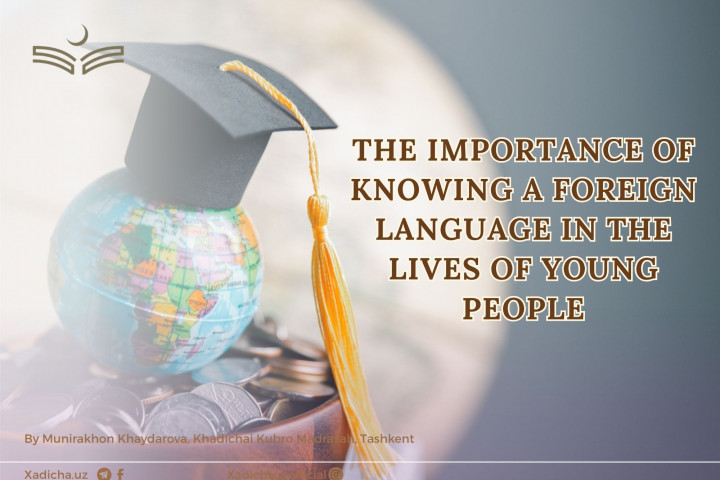
The Importance of Knowing a Foreign Language in the Lives of Young People
By Munirakhon Khaydarova, Khadichai Kubro Madrasah, Tashkent
Abstract
In the modern era of globalization and technology, knowing a foreign language has become a powerful tool for youth to access knowledge, communicate internationally, and build successful futures. This article discusses the significance of foreign language learning for young people, emphasizing not only its academic and professional benefits but also its moral and personal impact. The discussion highlights how language learning promotes intercultural understanding, broadens perspectives, and strengthens one’s identity as a representative of one’s nation and faith. Special attention is given to the importance of English and other foreign languages for students at Khadichai Kubro Women’s Madrasah, where education integrates intellectual, spiritual, and cultural growth.
Keywords: Foreign language learning, youth development, education, communication, culture, moral values
Introduction
Language is one of the greatest gifts given to humanity. Through language, people express ideas, share emotions, and build relationships. In the past, knowing one’s native language was often enough for daily communication. However, in today’s interconnected world, knowledge of at least one foreign language has become essential. Whether in education, travel, business, or online communication, young people increasingly need to understand and interact with speakers of other languages.
For students in Uzbekistan and especially for learners at Khadichai Kubro Women’s Madrasah, learning a foreign language — particularly English — opens new doors to global understanding and opportunities. It enables them to read international literature, access modern knowledge, and share the rich moral and cultural heritage of Uzbekistan with the world. Beyond these practical benefits, language learning also plays an important role in shaping a young person’s moral and spiritual development.
Foreign Language Learning in the Modern World
In the 21st century, foreign language knowledge is no longer a luxury; it is a necessity. The internet, global education, and international collaboration have created a world where communication has no borders. English has become the global language of science, business, and diplomacy, while languages like Arabic, Turkish, Chinese, and Russian also hold growing importance.
For young people, learning foreign languages means gaining access to the world’s knowledge and opportunities. It allows them to study abroad, participate in international conferences, and build careers in various fields. Many modern professions — from medicine and education to tourism and technology — require the ability to communicate in more than one language.
However, language learning should not be viewed only as a career tool. It is also a path to understanding humanity. Each language carries the culture, traditions, and worldview of its people. When young learners study a new language, they discover new ways of thinking and broaden their minds.
The Role of Foreign Languages in Personal and Moral Development
Learning a foreign language develops not only the intellect but also the heart. It teaches patience, discipline, and empathy — qualities that are highly valued in Islamic and moral education. As students struggle with unfamiliar words and new sounds, they learn perseverance. When they communicate with people from other cultures, they practice respect and tolerance.
Moreover, language learning can strengthen one’s understanding of faith. For example, learning Arabic allows students to better understand the Qur’an and Islamic scholarship. Learning English or other languages enables young Muslims to share their faith and values with others in a respectful and educated way. In this sense, language becomes a bridge that connects different peoples and promotes peaceful coexistence.
At Khadichai Kubro Women’s Madrasah, where moral and spiritual education is integrated with academic growth, foreign language learning helps young women become confident, cultured, and responsible members of society. They can communicate with kindness, represent their beliefs with dignity, and contribute positively to both their communities and the world.
Educational and Social Benefits for Youth
There are many practical benefits of knowing a foreign language for young people. Educationally, it improves memory, critical thinking, and creativity. Studies have shown that bilingual individuals often perform better in multitasking and problem-solving. Language learners also develop stronger listening and communication skills, which are valuable in all areas of life.
Socially, foreign language knowledge expands a person’s horizons. It allows youth to make friends from different countries, learn about various cultures, and understand global issues more deeply. In Uzbekistan, where the younger generation is increasingly connected to the world, these skills are crucial for building a modern, open-minded, and respectful society.
Additionally, learning languages encourages national pride. When students compare their own traditions with those of others, they gain a clearer sense of who they are and where they come from. They learn that appreciating other cultures does not mean losing one’s own identity — it means enriching it.
The Teacher’s Role in Motivating Language Learners
Teachers play a vital role in inspiring students to learn foreign languages. A good teacher not only explains grammar and vocabulary but also motivates learners to explore the beauty of language and culture. Teachers who create engaging lessons, use real-life examples, and show passion for learning can greatly influence students’ motivation.
In madrasah settings, teachers can also emphasize the moral purpose of language learning — to seek knowledge, communicate with wisdom, and serve humanity. Quoting the hadith “Seeking knowledge is an obligation upon every Muslim,” educators can remind students that learning languages is part of that noble pursuit. By understanding other cultures, students become capable of spreading kindness and understanding in a world that often faces division.
Conclusion
The importance of knowing a foreign language in the lives of young people cannot be overstated. It is a tool for education, a path to personal growth, and a bridge between cultures. For students at Khadichai Kubro Women’s Madrasah, foreign language learning holds even deeper meaning — it combines intellectual development with moral and spiritual enrichment.
When young people learn new languages, they do more than memorize words. They open their hearts to the world, learn to respect differences, and strengthen their own values. In this way, they become the true representatives of a peaceful, educated, and compassionate generation — capable of building understanding between Uzbekistan and the global community.
References
Byram, M. (1997). Teaching and assessing intercultural communicative competence. Multilingual Matters.
Kramsch, C. (1998). Language and culture. Oxford University Press.
Lightbown, P. M., & Spada, N. (2013). How languages are learned (4th ed.). Oxford University Press.
Woodrow, L. (2018). Introducing course design in English for specific purposes. Routledge.
Viana, V., Bocorny, A., & Sarmento, S. (2019). Teaching English for specific purposes. Cambridge Scholars Publishing.
Другие новости




Наши контакты
| Телефон: | +998 (71) 248-47-52 |
| E-mail: | xadichai-kubro@umail.uz |
| Адрес: | Toshkent shahar, Olmazor tumani, Fayziobod ko'chasi, 1-uy |